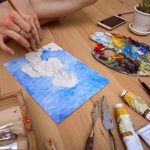

A flat wash and a graded wash are made with many of the same tools, but require very different manipulation of water and pigment. Flat washes are intended to have a consistent value across the entire form. A graded wash has the opposite intention, and you want it to change from dark to light as you travel across the page. While practicing both will be helpful, if you don’t have complete mastery over your brush yet, you’ll probably find a flat wash a more useful starting point. This technique exposes issues with your brush load, speed of application and overlap of brushstrokes in an easy-to-see manner.
For a flat wash, mix the color you need before applying it to the paper. A small puddle of color is better than mixing more pigment mid-way through your shape. Load a round or flat brush and apply your first stroke over dry watercolor paper. You should see a small bead of wet paint along the bottom edge of your paper. Your next stroke should slightly overlap that bead, allowing the wash to progress downward. You want to maintain a wet working edge as you go, while keeping the strength of color relatively constant.
Often you’ll see uneven stripes if your brush dries out between applications, or if some areas get much more liquid than others. Rewetting a patch that has begun to dry can make the problem worse. Rather than trying to go back and fix what’s already there, apply the entire wash in one direction and allow it to dry fully. You’ll be able to see more clearly whether you had an uneven brush load, lost the wet edge or applied too many correction strokes. Using a bigger brush may help here, as the wash will take longer to set over a large piece of paper.
With a graded wash, you must make an additional choice: you need to decrease the strength of color as you apply it. Start with a strong color at the top of your small rectangle. After you’ve applied your first couple of strokes, remove some of the color from your brush or add some water to your puddle. Then, continue pulling your wet bead down the paper, while gradually decreasing the amount of pigment. You want the change to occur over several strokes, not all at once. If you add too much water too quickly, you can cause the water to flow back into the previous wash, resulting in a bloom.
To compare the two types of washes, you could split a piece of paper into two similar rectangles. Paint the first one as uniformly as you can with a single color. Then, paint the second one with the same color, but diluting the color as you go down. Use the same paper, brush and approximately the same amount of water. Viewing the two examples side-by-side will make it much clearer to see where the water control and value changes occur. It will also remind you to pay attention to the wet bead, not just the tip of your brush.
Flat washes teach uniformity. Graded washes introduce change. Once you can apply a flat wash without obvious dry patches, puddles or repeated brush strokes, the graded version becomes much easier to grasp. When you’re comparing your results, look for the evenness of the flat wash and the smooth transition of the graded one. That’s more helpful than attempting to perfect either exercise.